

Choosing Life in the Age of Rigidity
How our world can learn to bend, so that we do not break.

This is an edited transcript of a talk I gave at the Portland Psychedelic Symposium on October 5, 2024.
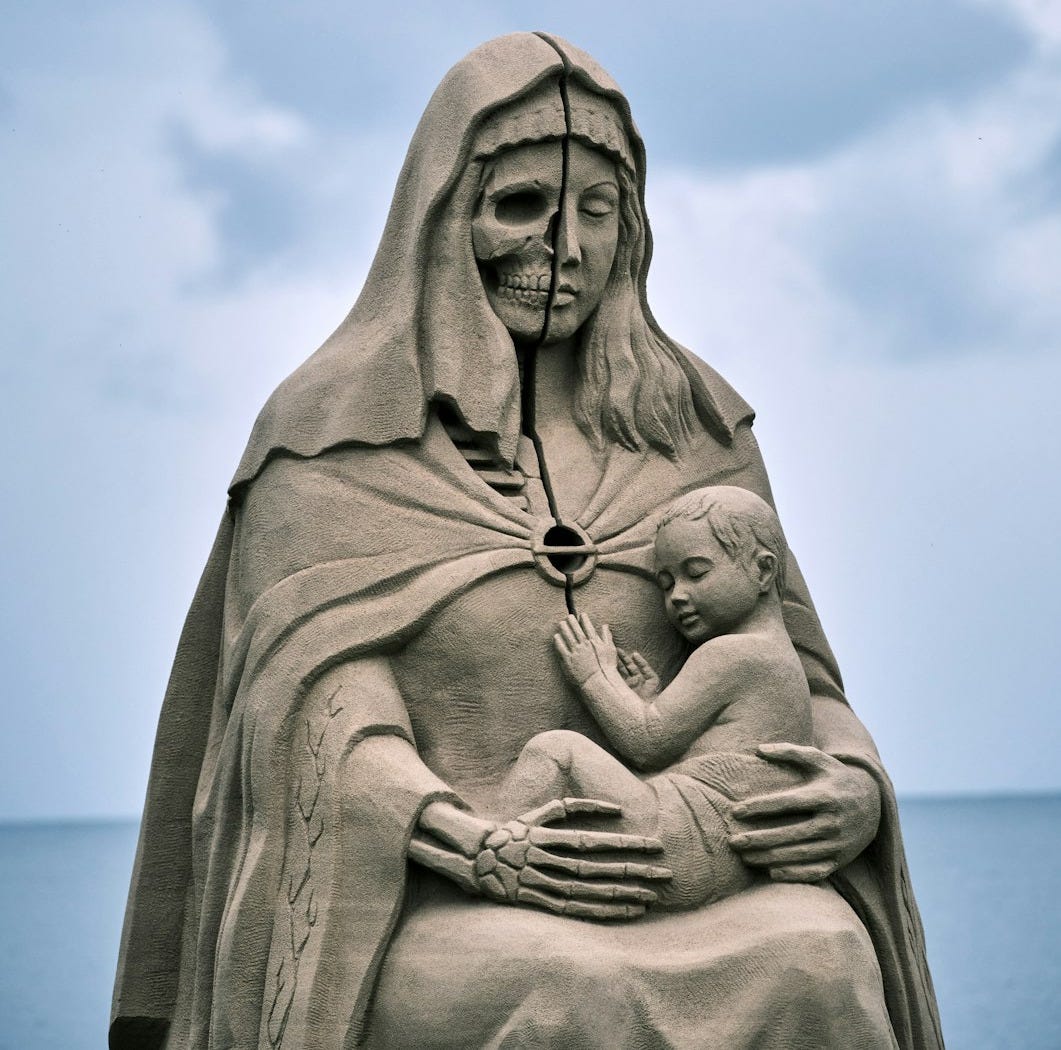
There’s a strong sense among people today that we’re living amidst dark times. We are teetering on the corners of a dozen or more existential risks to humanity with world-ending potential: things like nuclear war, environmental catastrophe, disease pandemics, AGI, economic collapse, and so on. The pall over humanity hangs heavy in our age.
At the same time, the world emanates great radiance. Psychedelics are reemerging on a global scale. Revolutionary medical treatments are being developed. People are working out longstanding ancestral traumas that have plagued lineages since time immemorial. And there does seem to be a collective awakening out of the disenchanted consumerist slumber that humanity has been sleepwalking through for decades.
So I always turn back to this phrase that I think is the most succinct summation of the reality of our times right now, which is, “Things are getting better and better, and worse and worse, faster and faster.” Therefore, as much darkness as you go searching for, you will find; as much light as you look for, you will find.
It is one of the expressions of the yin and yang of reality that our times are demanding we face. The problem is that the internet age pushes so much in our faces all the time that it becomes overwhelming to face the dynamic unfolding of reality’s apparent contradiction.
This is why the theme of this symposium is “illuminating visions.” We need those with vision to lead us in the proper direction through this confusing, distracting, winding human landscape. And we need illumination in order to highlight what should be the proper focus of our otherwise scattered attention, so that we may see clearly even amidst dark times.
At times when I need to refresh my vision, or when I’m searching for illumination, one of the places I turn is the Tao Te Ching. I’d like to recite a few lines that I believe offer us guidance on how to navigate this moment in time:
A man is born gentle and weak.
At his death he is hard and stiff.
Green plants are tender and filled with sap.
At their death they are withered and dry.
Therefore, the stiff and unbending is the disciple of death.
The gentle and yielding is the disciple of life.
One of the problems that our world is facing—and in my mind it’s one of the central problems—is rigidity. We see this play out in many forms in our world, but particularly in people’s belief structures and discourse, and especially in the discourse we see in the internet domain.
People have become rigidified by being pulled down algorithmically-insinuated reality tunnels, where both Person A and Person B are looking at the same thing and drawing completely different conclusions about the reality of the situation—both being absolutely convinced beyond a sliver of a shadow of a doubt that they're right. This is rigidity; this is the stance of death.
We can think of the circulatory system of the human body: blood needs to flow through the arteries, and when the arteries become calcified, it leads to heart disease. Well, we're witnessing the proliferation of a psycho-spiritual heart disease in the body of our culture. And now when fresh blood tries to deliver nourishment throughout the system, the calcified passageways of our thinking restrict its flow.
Look at what has happened with agriculture over the past 75 years. The world’s farmers have adopted the model of monoculture in order to mass produce food with ruthless efficiency. With monoculture farming you might have a 1,000-acre field of only corn, of all the same genotype and phenotype.
That's obviously not how nature “wants” to work. So we need to concoct all manner of poisons to keep blooms of weeds and insect populations and microbes and molds from decimating crops. We are witnessing myriad ways this is a losing battle. Likewise, when we're producing monocultures of worldview, our thinking becomes unnaturally sequestered. We think our view is the only crop worth growing, and that the genotype and phenotype of that view is the only right expression, and that to try other crops would be pointless and dangerous. Again, this is rigidity. This is the stance of death.
The stance of life is flexibility. When people’s minds become pathologically inflexible, our clinicians diagnose them as mentally unwell. When minds are flexible and adaptive and lively, they are considered healthy.
We know from neuroscientific research on psychedelics that part of what they're doing in the brain is allowing for cognitive flexibility. They allow for neuronal connections to be made that break people out of the rigid patterns that prevent them from seeing things clearly. These are patterns that manifest as depression, anxiety, suicidality, and so forth that keep people from seeing and feeling that sacred core of their inviolable, infinite, inimitable, and intrinsic worth.
To paraphrase Terence McKenna, what psychedelics do and the reason that they’re such social dynamite, to use his phrase, is that they allow us to see ourselves as ourselves, beyond the cultural trappings and impositions that have been thrust upon us simply by being born into this world.
We are here, then, to co-discover an illuminating vision, a better way, that beckons us forward with the flexibility we need to navigate nimbly the shifting grounds beneath our feet. We are here to remember who we are and what we’re here to do. To figure out how we can navigate this particular moment in time, amidst the complex of dire predicaments we find ourselves in.
Anybody who's gone to school can tell you that a large degree of true education is actually the process of unlearning. Of course, there's an infinitude of valuable information to learn, and that's important too. But we have a lot to unlearn because cultural infrastructure carries its own momentum; and because we are embedded in culture, it carries us right along with it.
That momentum is how we’ve arrived at the place where our soil is devoid of nutrients (despite nobody wanting that because we all have to eat the food), where our world is on the brink of world war (despite nobody wanting that because we all live here), where we're consuming a credit card's worth of microplastics a week (which nobody wants because we all like being alive), and hundreds of other examples just like these. So we have these cultural systems that are moving against our best interests and our hearts’ desire both (which if we're integrated as a people, should map directly on top of each other).
However, it's not all terrible. Again, it goes onward in both directions. We have many systems that work too. When I flick a light switch, lights come on. It's a miracle we take for granted (and we live in a place where we're fortunate enough that that's the case). I can hop on a bus and ride anywhere across town at almost any hour of the day. I can go to the supermarket or farmer’s market and purchase just about any food item I want. Of course, there's cracks in the veneer of any system if you look closely enough, but some systems are working well. This is not even to mention all of the knowledge and the wisdom that's been carried forward through the systems of oral tradition and writing for millennia.
Therefore we can't burn it all down and start from scratch, because all of the hard-earned worthwhile cultural systems will burn along with it, which would lead to massive chaos and untold suffering. And we can't allow things to keep going as they are because the suffering that's causing is already far beyond humane limits. So, how do we find the way through? How do we thread the needle to move beyond human survival and unto to human flourishing?
Well, that's part of what we're here to try to figure out—how can we bring about the more beautiful world our hearts know is possible? We can’t be so naive to think that there's only one way to do that; again, the monoculture represents the path of death.
To me, the way will be found through taking the stance of the Tao, which is the stance of both-and-neither. By no coincidence, this is also the stance of the psychedelic experience. Psychedelics lower those defensive buttresses that tell us everything we believe is right and absolute; they decalcify those psychological arteries so that vital life can flow freely.
I think anybody who's taken a high dose of psychedelics will tell you that everything is more complex and interconnected than we can imagine. That understanding often comes alongside the feeling of oceanic boundlessness, a sense of universal consciousness, and the recognition of being part of a human family—a family of all beings. It also comes with the understanding that love has primacy, that love is the most important thing.
Interconnectedness and love—to me, these are the core messages of the psychedelic experience. These are things we all know as children, but we forget. So this is why we're here. We're here to remember.
Remembering is not the opposite of forgetting. The opposite of remembering is dismembering. We've been dismembered by the harsh realities of our world, of the culture we've created/inherited. What we need is integration. It’s time to re-member. We know what we’re here to do. We know that we’re here to help.
So instead of pulling people down algorithmically-enforced reality tunnels that create the terrifying circumstance where even understanding what is objectively true is starting to become impossible, can we instead pull everyone in—the way that an embrace pulls the other into the heart—into the space of feeling, of human connection, into the space of seeing the other as a fellow experiencer of the incredibly challenging and rewarding human condition, rather than as an avatar of ignorance or evil?
My vision of illumination moving forward is that psychedelics can serve as a nexus point of all of the ostensibly-distinct reality tunnels, where we come out the other end remembering that we're one human family facing the travails of life side by side by side. And remembering that we’re all on the same boat, so that we may set sail for the most beautiful and fruitful domain we can possibly conceive of.
And may we recognize the truth that we create culture moment by moment as we live it. And as much as it carries its own momentum, it carries infinite capacity for transformation. Therefore if we can transform ourselves, we introduce transformation into the cultural stream, which will become then immediately shifted.
And when we come together in community and transform ourselves collectively while offering and receiving support, encouragement, and good faith, we have already transformed the multitude of other communities we're embedded in for the better.
So this, in my opinion, is why we’re here this weekend. Let’s transform together. And we can begin by opening our hearts and minds to the tapestry of illuminating visions that is going to be woven over this special weekend by all of our phenomenal speakers, and all of you participants in attendance today.
Thank you.